Why confidence is the new currency in the aftermarket

The aftermarket has a
confidence problem
A resilient market, but buyer behavior has changed
The aftermarket has been a steady engine for manufacturers for decades: resilience where new equipment sales are cyclical, predictable where end-market demand is volatile. But something has shifted. The buyers who once called their distributor contact or waited for a quarterly account review are gone. In their place: a new generation of procurement and service professionals who have grown up in a world of instant answers, and who see no reason the industrial aftermarket should operate any differently.

Millennials and Gen Z are now the majority of buyers
According to research from Copperberg & Sana Commerce, 71% of today’s industrial buyers are Millennials or Gen Z. Nearly three-quarters prefer to order online – through a supplier’s website or portal. They carry the habits of consumer commerce into the B2B world, and they will not leave those habits at the door.

Portals exist but they’re undermining confidence
The problem is not that manufacturers lack digital channels. Many have invested heavily in e-commerce infrastructure. The problem is that 85% of B2B buyers will report frustration when ordering online, and 75% say they would switch suppliers for a better digital experience. These portals exist, but the experience they deliver undermines the very thing manufacturers need most: buyer confidence.

Downtime turns every order
into a high-stakes decision.
Downtime turns every order
into a high-stakes decision.
These aren’t abstract figures. They are the exact numbers flashing through a buyer’s mind when they place a parts order. Every decision to use a reseller instead of the OEM portal is a risk, one that buyers take only when they no longer trust that the official channel will deliver.

The grey market
A symptom of a digital gap
OEMs lose a significant share of aftermarket revenue every year to third-party distributors. It’s tempting to frame this as a pricing war—a race to see who can deliver the cheapest part the fastest.
That framing misses the root cause. Independent resellers don’t succeed because they are better; they succeed because they fill the gaps OEMs leave open. When a buyer can’t easily verify a part’s compatibility or find live inventory, they reach for an alternative. But that "quick fix" comes with significant baggage.
The hidden costs
of the "alternative"
The hidden costs
of the "alternative"
When a customer steps outside the official channel, they trade certainty for a gamble. We see three major risks that buyers (and OEMs) often overlook:

The compatibility trap
Without access to your live ERP data, third-party sellers are guessing. A part that "looks right" on a screen can lead to critical system failures or safety hazards when it doesn't align with the equipment's actual specifications.
The "no-man's-land" of support
Grey market parts rarely come with a manufacturer’s guarantee. When a part fails, the buyer has no recourse, no warranty, and no technical support. They are on their own.
The brand backfire
If an unauthorized hydraulic component fails, the customer rarely blames the cheap part. They blame the name on the machine. Your brand carries the weight of the failure, even if you didn’t sell the part.
Why leakage happens:
The three root causes
Why leakage happens:
The three root causes
Buyers don't want the risk; they want the path of least resistance. They turn to the grey market when they encounter:

Customers turn to alternatives when OEMs lack a functioning web store or self-service portal.

Incomplete search logic, poorly structured product data, and inconsistent pricing leaves buyers frustrated enough to try anything simpler.

When ERP, CRM, and PIM data live in separate silos, pricing, inventory, and lead times never quite align.

Connecting your ERP
to the point of purchase
OEMs already hold every asset a buyer actually values: expert product knowledge, authentic verified parts, established relationships, and reliable data sitting inside their ERO systems. The challenge is connecting those assets in real time and making them visible at the point of purchase.
Beyond revenue, there is a safety dimension that is easy to overlook. Grey market parts, particularly those sourced from low-cost regions, may be counterfeit or substandard. When a fleet operator buyers unauthorised hydraulic components and the system fails, they don’t blame the cheap part. They blame the OEM whose brand is on the equipment. Confidence in the official channel isn’t just a commercial advantage; it’s a brand protection imperative.
The new buyer:
higher stakes, lower patience
The new buyer:
higher stakes, lower patience
Today’s aftermarket buyers are technical, data-literate, and impatient with inefficiency. They have been shaped by a world in which Amazon can surface the right product, confirm availability, and guarantee delivery in under 30 minutes.
They see no reason why ordering a replacement part should be any more complicated.
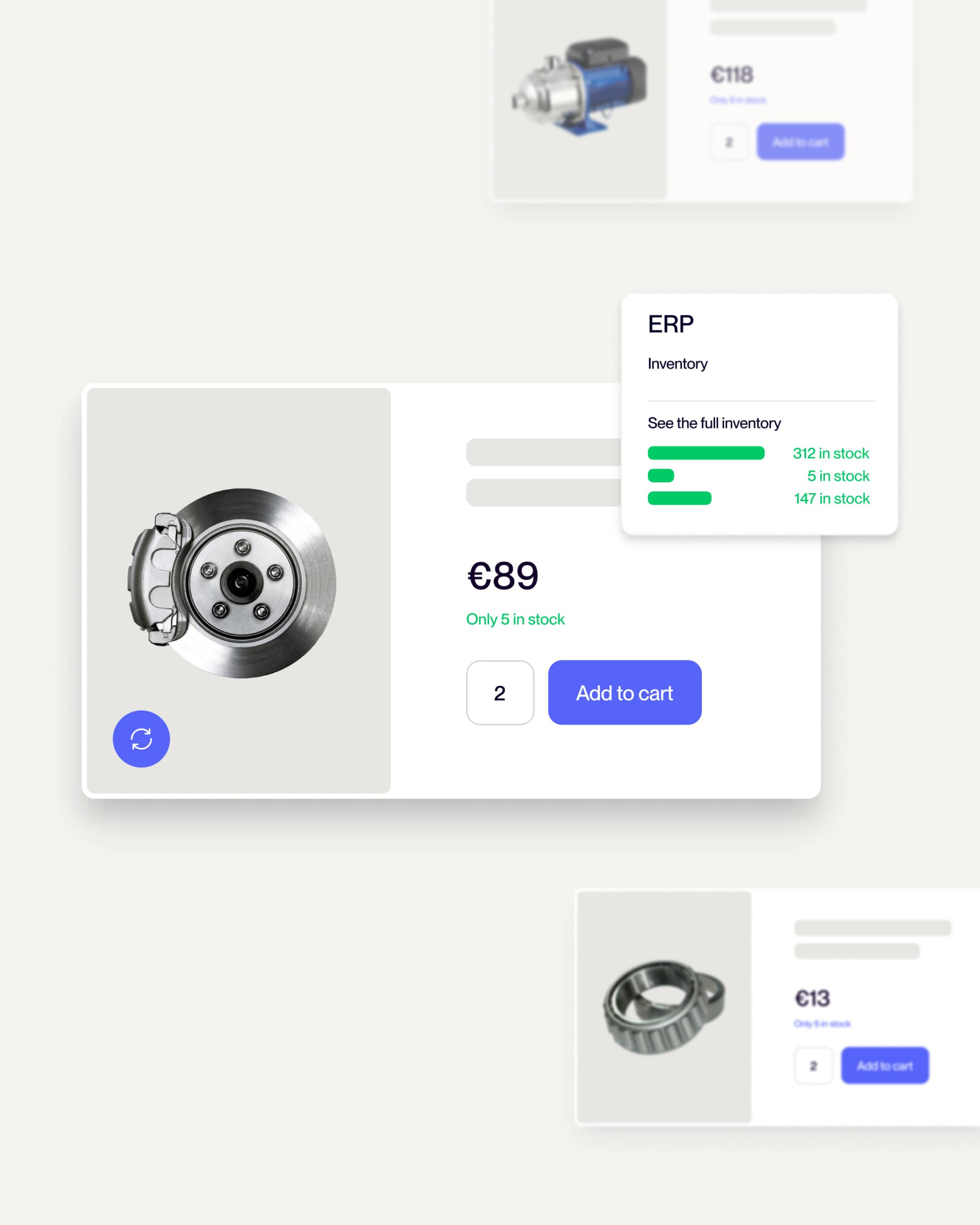
These expectations create a very clear hierarchy of what buyers actually need from an aftermarket portal
- Real time visibility into stock levels, accurate pricing, and confirmed delivery timelines, all before an order is placed.
- Personalized catalogs that reflect their installed base, service contracts, and purchasing history.
- Search tools that surface the correct part number reliably every time.
- Consistent pricing across quotes, portals, and invoices.
- Delivery estimates that can actually plan around maintenance schedules.
None of these are unreasonable. They are, in fact, the table stakes of modern commerce. The manufacturers who treat them as optional are, inadvertently, treating grey market leakage as acceptable.
Four steps to start winning back revenue
The path forward is clear. Manufacturers that invest in real-time data, connected systems, and a buyer-focused digital experience will reclaim lost revenue, build stronger customer relationships, and get back in control of their aftermarket business. Here is where to start:

Map the flow of information between ERP, CRM, PIM, and other operational systems. Identify precisely where delays or data mismatches slow orders or undermine buyer confidence. The audit will reveal the gap — and the gap is usually smaller than expected.
Ensure live synchronisation for pricing, availability, and delivery data across every customer-facing touchpoint. Buyers notice accuracy, and they remember when it is missing. This single investment addresses the root cause of most grey market leakage.
Build around how customers actually buy: machine-specific catalogs, guided search, effortless reordering. Remove every unnecessary step between a buyer’s need and the completed order. Simplicity and accuracy are not in tension; with the right integration, they are the same thing.
Once the data foundation is solid, use AI to forecast demand, automate replenishment, and surface relevant upsell or service opportunities before buyers ask. This is where the portal evolves from a channel into a strategic growth engine.

The bottom line
In today’s aftermarket, success is measured by how consistently you deliver on your promises. When every stock count is accurate, every price is consistent, and every delivery estimate proves reliable , trust grows. And trust is what keeps customers coming back, and keeps them away from grey market alternatives entirely.
The confidence gap is real, it is measurable, and it is costing OEMs revenue they should own. But it is also entirely closeable. The data exists. The systems exist. The only thing standing between manufacturers and a loyal, high-margin aftermarket customer base is the decision to connect them.