Arno Ham on the digital gaps costing manufacturers aftermarket revenue

For manufacturers, aftermarket has long been seen as a dependable revenue stream. But that picture is changing. Revenue is leaking through fragmented buying journeys, poor product data, and growing grey market competition. What looks like a channel problem is often something deeper: a digital experience that no longer matches how B2B buyers want to buy.
That is one of the central themes behind our recent whitepaper, and it is where Arno Ham believes manufacturers need to focus. In this interview, he explains why confidence matters more than speed, why ERP-connected commerce is still foundational, and how manufacturers can turn aftermarket from an efficiency play into a growth strategy.

The Copperberg whitepaper frames grey market competition as a symptom of digital gaps. What does that mean in practice?
Arno: It starts with understanding where the leakage is really happening. That means talking to distributors, service centers, and partners to see what is driving behavior in the market.
Often, the issue is not just price. Local players have different needs. Some want to sell their own brands. Some need more flexibility. Some want to serve customers digitally but do not have the tools to do it well.
That creates an opening for the manufacturer. If you understand those needs, you can define the role you want to play in the ecosystem. That might start with an aftermarket portal. Over time, it could develop into more of a marketplace model.
The key point is this: manufacturers can still own the buyer journey, even in a market that includes third-party products or local variation.
So the grey market is not just about cheap replica parts. It is also about the wider local ecosystem?
Arno: Exactly. It is broader than many manufacturers think.
Yes, there are replica and lower-cost alternatives in the market. But there are also distributors and service organizations that want to sell private label or complementary products.
If the manufacturer owns the digital channel, it can still shape that buying decision. It can show the difference between a genuine OEM part and an alternative, not only on price, but on expected lifespan, performance, or even sustainability.
That is where digital control becomes strategic. You are not just listing products. You are influencing the buying decision.
You make the case that confidence matters more than speed in B2B buying. Why do so many OEMs still get that wrong?
Arno: Because speed is easy to market. Confidence is harder to build.
In aftermarket, the real problem is rarely that something arrives the next say instead of the same day. The real problem is when the wrong part arrives quickly. That creates downtime, frustration, and more cost for the customer.
So yes, fast delivery matters. But only if the promise is reliable. In B2B, buyers value certainty. They want to know they are ordering the right product, at the right price, with accurate availability.
That is why accuracy comes first. Speed only matters when it is backed by trust.

With millennials and Gen Z now making up most industrial buyers, what is the biggest mistake manufacturers make in underestimating how these buyers behave?
Arno: They underestimate how natural digital self-service feels to this group.
These buyers do not want to wait for office hours, phone calls, or rep visits for routine tasks. They expect access when they need it. That could be during the workday, but it could just as easily be later in the evening when they finally have time to review orders.
For a smaller service center or distributor, that flexibility matters. They want to check stock, place orders, and move on. They expect the tools to be there, and they expect the information to be accurate.
The biggest mistake is assuming they will adapt to an outdated buying process. They will not. They will compare it to every other digital experience they already have.
Buying a spare part is obviously more complex than buying a consumer product. Is the challenge cultural or technical?
Arno: It is mainly about bridging expectations and complexity.
B2B buyers now expect a smooth, intuitive experience. But the environment behind that experience is much more complicated than in consumer commerce. You have customer-specific pricing, technical dependencies, availability issues, and large assortments.
That gap cannot be solved with messaging alone. It needs the right technology.
The real opportunity is to make complex commerce feel simple. That is where strong B2B commerce adds value.
What does “real time” actually mean in a manufacturing environment?
Arno: Real time only matters if it connects to the truth.
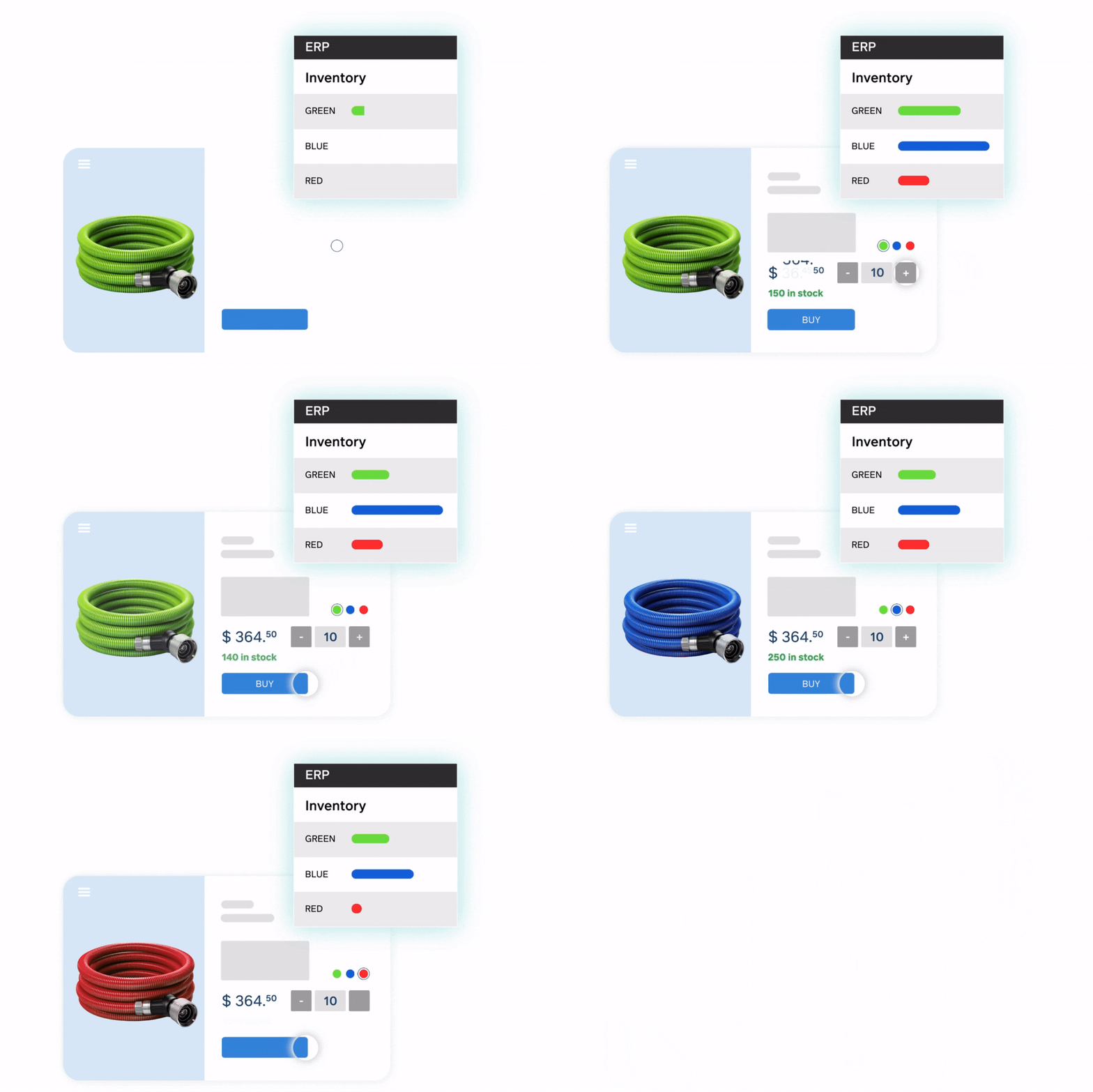
In most manufacturing environments, that truth sits in the ERP. That is where you find stock, pricing, customer agreements, and available-to-promise information.
If your digital channel is not connected to that source of truth, then “real time” becomes a marketing phrase instead of a real capability.
This matters even more as commerce becomes more conversational and AI-driven. Buyers will increasingly expect immediate answers. Those answers have to be trustworthy, and that only happens when the commerce experience is connected to the right data source.
Where do manufacturers tend to overestimate the quality of their data?
Arno: Usually right after they invest in a system.
A company can implement a strong ERP and still have incomplete data, missing prices, inconsistent product information, or broken rules. Systems matter, but they do not remove human error.
The real question is not whether you have a core system. It is whether you have the visibility and discipline to catch data issues before customers run into them.
Digital channels expose data problems very quickly. In that sense, they are useful because they force the business to confront what is not working.

Sana Commerce talks more and more about the web store as a growth engine, not just an efficiency tool. What changes at that point?
Arno: The mindset changes first.
Most companies begin with efficiency goals. They want fewer manual orders, fewer errors, and less internal friction. That is a good starting point.
But the bigger shift comes when they realize aftermarket is not just something to streamline. It is something to grow. In many businesses, it already represents a significant share of revenue, and margins are often strong.
That is where the ecosystem view becomes important. Once a manufacturer starts serving not only the end buyer, but also distributors, service centers, and local markets, the digital channel becomes much more powerful.
Predictive aftermarket sounds compelling, but also a little distant for many manufacturers. What is the practical first step?
Arno: Start with the data you already have.
Many manufacturers do not need to begin with machine sensors or advanced connected-product data. They already have valuable signals in their ERP, especially around transaction history and purchasing frequency.
That can support simple but useful improvements. You can recommend likely replacement parts. You can surface alternatives. You can improve search and product guidance. You can make repeat buying easier.
That is what makes predictive aftermarket more realistic now. It does not have to begin with a huge transformation program. It can start with making better use of existing data. The next steps would involve looking into more advanced scenarios, leveraging machine sensors.
When manufacturers successfully win back aftermarket revenue, what do they tend to get right?
Arno: They commit to the journey.
The strongest companies take the time to understand their ecosystem. They look at where grey market pressure comes from, what partners need, and where they can add real value.
Then they build step by step. They improve the data foundation. They strengthen the buyer journey. They expand into more complex use cases. And over time, they create a digital model that is much harder for the market to work around.
That is what good looks like. Not one big launch, but a repeatable growth playbook.
Hear more from Arno
Hear more from Arno
Why do B2B buyers abandon digital channels at the moment they are most ready to buy? Sana Commerce and Forrester are researching exactly that, and Arno Ham will be sharing early findings in a live webinar.


